

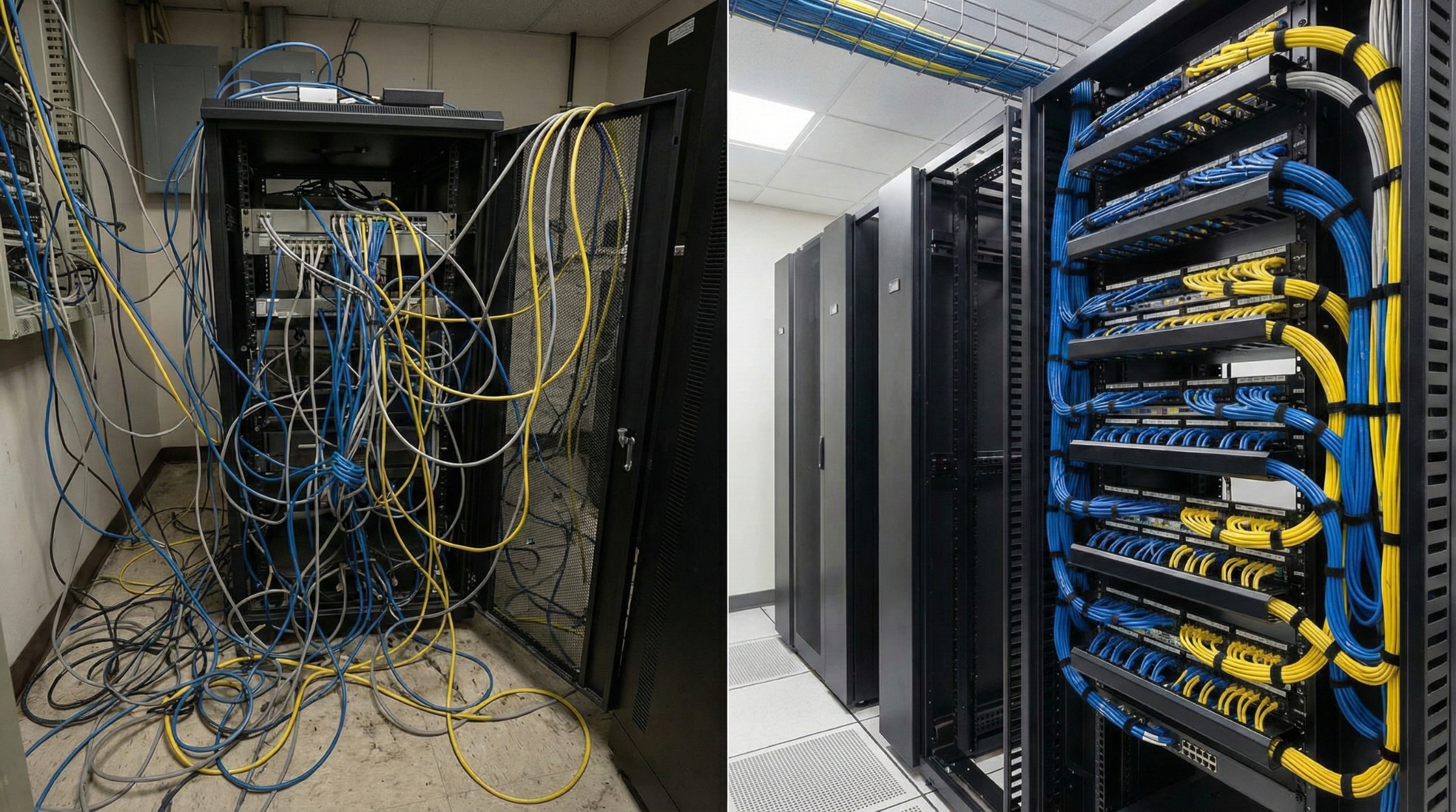
Walk into almost any small business server room or IT closet, and there is a high probability you will encounter the "cable monster." It is that tangled, chaotic web of blue, white, and yellow cords spilling out of a rack, draped over equipment, and snaking across the floor. While it might seem like a minor cosmetic issue, the reality is that your physical data infrastructure is the critical backbone of your business network.
If the backbone is weak or disorganized, everything else, from your cloud applications to your VoIP phones, will eventually suffer. Structured cabling is the solution to this chaos. It’s a planned, standardized approach to your building’s wiring that ensures your technology can perform at its peak today and stay ready for future growth.
A messy server room is more than just an eyesore; it is a significant operational liability. When cables are tangled and unlabeled, it becomes nearly impossible for an IT professional to troubleshoot a connection issue quickly. What should be a five-minute fix can turn into hours of expensive downtime as a technician traces a single line through a "spaghetti" mess of wires. In a professional environment where every minute of downtime costs money, this is a risk no business should take.
Furthermore, poor cable management restricts airflow. Servers and switches generate significant heat, and when cables block exhaust vents or intake fans, you risk hardware failure. Heat is the number one enemy of electronic equipment. This situation falls right into the trap of the dangerous mindset of "just getting it working," where temporary fixes create massive long-term risks for your hardware and your data.
Investing in professional data cabling provides several immediate benefits to your business operations:
1. Increased Network Speed and Reliability
High quality Category 6 (Cat6) or Cat6a cabling, installed correctly, ensures you are getting full bandwidth. Kinks, sharp bends, or proximity to electrical interference can significantly degrade your speeds. Professional installers understand how to route cable to avoid electromagnetic interference from lights and power lines, keeping your data flowing without interruption.
2. Safety and Compliance
Loose cables are a tripping hazard for employees and visitors alike. Beyond physical safety, there are strict building codes to follow. For example, using the wrong type of cable in ceiling spaces can be a fire code violation. Professional installers ensure every foot of wire is tucked away safely and is fully compliant with local regulations.
3. Aesthetics and Professionalism
If a client, investor, or potential partner walks past your IT closet, what do they see? A clean, labeled, and organized rack sends a message of discipline and high professional standards. It shows that you care about the details of your infrastructure. Conversely, a mess suggests a lack of foresight and can negatively impact your professional image.
4. Efficient Troubleshooting and Maintenance
With a structured system, every port in your office corresponds to a clearly labeled port on a patch panel. This makes regular IT network health checkups much more effective. When a workstation loses connectivity, the fix is as simple as identifying the labeled port and testing that specific line, rather than guessing which wire in a bundle of hundreds is the culprit.
There is a common misconception that in the age of wireless, cables are becoming obsolete. However, in a professional business environment, relying purely on Wi-Fi can be a recipe for frustration. While wireless technology has improved, it still cannot compete with the stability and dedicated throughput of a physical copper or fiber line.
Wireless signals are shared resources. Every device connected to a single access point is competing for a slice of the same bandwidth. If several people are on a video call while others are performing large cloud backups over Wi-Fi, performance will likely suffer. Beyond bandwidth limits, Wi-Fi is susceptible to environmental interference from walls, metal shelving, and other electronics. For mission-critical tasks like VoIP calls and large database or file access, the reliability of a wired connection is essential to prevent dropped calls and data corruption.
Even when you do use Wi-Fi, the quality of that wireless signal is directly dependent on the quality of your structured cabling. Wireless Access Points (WAPs) are essentially bridges that translate wired data into a wireless signal. If the wire feeding that WAP is old, damaged, or poorly installed, your wireless signal will be slow and unreliable regardless of how advanced your router is. It may not be getting enough PoE (Power over Ethernet) either, or it may be traversing floor switches that can lead to network loops and additional points of failure.
A professional cabling plan ensures that your WAPs are placed in optimal locations for coverage and are powered correctly. Relying on "mesh" systems or wireless extenders without a wired backhaul often leads to signal degradation, which can bring productivity to a halt during important video calls or cloud-based tasks.
Structured cabling is not just for fixing an existing mess. There are several key moments in a company’s lifecycle where professional cabling is essential:
Your network is only as strong as its weakest link. You can have the fastest fiber internet in the city and the most expensive servers, but if the signal is traveling through a poorly terminated, tangled mess of wires, you are not getting the performance you deserve.
At Auriga Technology, we believe in doing things the right way from the ground up. We want every customer to have an IT closet and data cabling that any company would be proud of. This means infrastructure that not only offers peak performance but is also clutter-free and easier to troubleshoot when issues arise. Whether you are moving into a new suite or have finally decided to tame the monster in your current IT closet, professional structured cabling is the foundation for a reliable, high-performing business.


.png)